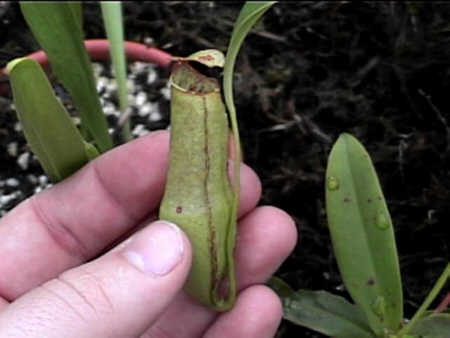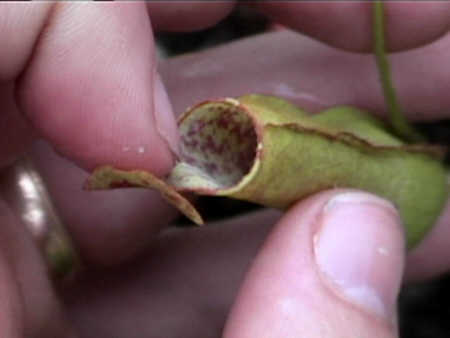




Lowland varieties enjoy warmer
temperatures, and naturally grow at low elevations. I own a Nepenthes
gracilis, which is in this group. This is one of the first Nepenthes
that anyone should start with; it's easy to maintain, not too fussy about light,
and easily pitchers. Some varieties grow very
quickly, and can outgrow a terrarium in a very short time. Following is a brief list of some of the lowland types. I underlined
those I do own.
| albomarginata |
ampullaria |
bellii |
bicalcarata |
| campanulata |
decurrens |
globamphora |
gracilis |
| insignis |
kampotiana |
merrilliana |
mirabilis |
| neglecta |
neoguineensis |
northiana |
papuana |
| petiolata |
rafflesiana |
reinwardtiana |
thorelii |
| tomoriana |
trichocarpa |
truncata |
|
Growing Media:
- No matter what media you use,
make sure it is well-drained. These plants hate to be standing in
water too long. I use a mixture of peat moss, perlite, and orchid
bark. Again, I top dress the soil with Sphagnum Moss.
Temperatures:
- Textbooks claim to grow
lowlands in temps ranging 70-85F. However, my Nepenthes gracilis
has been grown outside in temperatures up to 100F. Growth was faster
than one inside at 75F-80F. I left the plant standing in half an inch
of water, to prevent it from drying out. I plan on growing two
different Nepenthes outside later this year. I also stuck out
a Lowland Hybrid, N. x coccinea, because I had no room inside for it.
It lived just fine in the summer at 100F.
Water & Humidity:
- Lowlands and Highlands both
like high humidity, and watering should be done when the soil starts to look
dry on the top.
Light:
- Full sun is recommended for
Nepenthes. For indoors, provide as much light as you would for Venus
Fly Traps. I found my Nepenthes even grow in low light. I have kept Nepenthes
gracilis and truncata under 40 watts of florescent light, and
they seemed fine. Next Spring, my truncata is moving outdoors.
Asexual Reproduction:
- Stem Cuttings: When the
plant has a healthy stem, cut of a piece with 1-3 nodes. Be sure not to cut
back too much of the stem, or the entire plant will die. Cut about 1/2 of
the leaf, Dust the cuts with fungicide, and the stem cutting with rooting
hormone and fungicide (Rootone works well, it is both a rooting hormone and
fungicide). Place the cutting is moist media for now, and place in
high sunlight with average temperatures. I have put my cuttings of N.
gracilis in a cup of water, and waiting until roots and new leaves appear
before placing in media. I also put one cutting low light for 2 weeks to
encourage faster root growth. I have used Superthrive with 1/2 of my
cuttings, and I did see a difference-- those plants with Superthrive did
grow faster and put out more roots. Unfortunately, I did not have a working
camcorder, and hence, no pictures. Once the cuttings have well
rooted and start to put out new leaves, then transplant CAREFULLY into a
larger pot.
Sexual Reproduction:
- Nepenthes are dioecious
(male and female flowers exist on different plants). If you have several
plants, and a few are blooming, then you may be able to pollinate them. When
I make a section on pollination, I will go a little further there.
 Picture available at the CP
Database, do a search on Nepenthes & the species.
Picture available at the CP
Database, do a search on Nepenthes & the species.
- N. albomarginata
- Green & purple pitchers up
to 6 inches long and 1.5 inches wide. Has a white tomentose ring around the
mouth of the trap, very unique. A climbing vine with leaves up to 10
inches long and under one inch wide. Available from a few on-line sellers.
-
- N. ampullaria
- A good terrarium plant, with
small green/red pitchers that are very round and short, averaging 3 inches.
Easy to find from sellers. Pitchers form mainly on the ground in a
spreading habit. The pitchers look like spittoons or urns, no hood actually
covers the pitcher, but it stands upright to laying over backwards. I'm in
the market to buy one or two... Great photos in Nepenthes of Borneo
by Charles Clarke!
-
- N. bellii
- Good for terrariums, stays
under control and small easily.
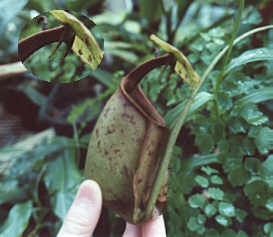
- N. bicalcarata
- Gets too big for a
terrariums after awhile, but worth the short stay! Has two 'teeth'
hanging from behind the lid, giving it a mean look, and they are
sharp! Leaves can grow over 2 feet, with pitchers up to
6-8 inches! Pitchers can be green to reddish, thick & woody.
A show-stopper of a Nepenthes! Can be found on several sellers' sights.
Dangerous Plants! has
another photo.
|
© Mark Pogany
|
-
- N. campanulata
-
- N. decurrens
- Very similar to N.
northiana.
N. globamphora
- N. gracilis
- Known to be the easiest of
Nepenthes to grow. If you never have tried them before, grow this one
first. Very easy to find from buyers, and I could have some rooted
cuttings on hand at any time. Green pitchers with some
reddish spots, only up to 3 inches long. Very fast growing vine, can easily
outgrow the average terrarium, but responds well to trimming. Easy to
propagate. Below are the pitchers.
-
- N. insignis
- Climbing vine, with leaves up
to 8 inches long. Lower pitchers can be up to 6 inches high with two
wings, while upper pitchers and can be 10 inches high! The mouth of the
pitchers has a red 'lip', very attractive.
N. kampotiana
- N. merrilliana
- Large plant with green
pitchers, ranging leaves over 20 inches! Lower pitchers are up to 8 inches
long, while upper pitchers can be up to 10 inches.
-
- N. mirabilis
- A good plant for large
terrariums. Actually preferes neutral to alkaline areas . Very tall and
skinny pitchers reaching up to 12 inches. Pitchers are green to light
red. I'm looking to buy one for myself.
-
- N. neglecta
- Leaves can be 10 inches long,
while the pitchers average 4-5 inches in height.
-
- N. neoguineensis
-
- N. northiana
- Pitchers up to 16 inches in
length, with a red, fringed wing over the mouth of the lid. Leaves are
thicker than most other Nepenthes, and can be over 12 inches long.
-
- N. papuana
- Leaves up to 5 inches long,
with 4-5 inch pitchers.
N. petiolata
- N. rafflesiana
Dangerous Plants! has
another photo.
- Be careful getting this plant
upset, the pitchers can be up to 2 feet tall! Has large fat
lower pitchers but long skinny upper pitchers. Typically, the plants'
pitchers are only up to six inches, and are green with red and purple spots.
A unique feature is the 'neck' from the pitcher to the lid. Vast
amount of hybrids exist, each with different but great qualities. Some
varieties even have the a distance between the leaf tip and the trap up to
five feet -- that's one long stem! Once I collect more data on
the hybrids, I'll put them in that section....HAH, yah right. Even so, you
can find then from the buyers quite easily...
N. reinwardtiana
- N. thorelii
- Native to Indochina. Lower
pitchers are oval-shaped and obtuse with fringed wings, tinted with a redish
hue. Upper pithcers are long and skinny, very yellow-green.
Found it for sale on several web-sites.
N. tomoriana
N. trichocarpa
- N. truncata
Dangerous Plants! has another
photo.
- Just got one not to long ago, a
very interesting plant so far, but slow growing. The leaves are
'truncated' at the end, meaning almost square (see picture). Large
pitchers (and I have it for indoors, DOH!) can reach up to 12". I'll
post a picture once the first trap forms, which shouldn't be too long.
You should be able to find it for sale with some ease.

Last Update April 13, 2000

Since 2/22/2000