




Highland varieties enjoy cooler
temperatures, and naturally grow at high elevations. It is important to prune
your plants correctly, to ensure a good size plant, and vigorous uniform growth.
With some Nepenthes, pruning is the first step in propagation of new plants.
Following is a brief list of some of the highland types. I underlined those I do
own, which isn't many. The need for lower temperatures limits me to growing them
indoors.
* denotes Picture available
at the CP Database, do a search
on Nepenthes & the species.
| alata
* |
anamensis |
bongso |
boschiana
* |
| burbidgeae |
burkei |
carunculata |
clipeata |
| deaniana |
densiflora |
dentata |
distillatoria |
| dubia |
edwardiana |
ephippiata |
fusca |
| geoffrayi |
gracillima |
gymnamphora |
hamata |
| hirsuta |
inermis |
klossii |
khasiana |
| leptochila |
lowii |
macfarlanei |
madagascariensis |
| maxima |
mollis |
muluensis |
paniculata |
| pectinata |
pervillei |
pilosa |
rajah |
| rhombicaulis |
sanguinea |
singalana |
spathulata |
| spectabilis |
stenophylla |
tentaculata |
tobaica |
| treubiana |
veitchii |
ventricosa |
vieillardii |
| villosa |
|
|
|
Growing Media:
- No matter what media you use,
make sure it is well-drained. These plants hate to be standing in
water too long. I use a mixture of peat moss, perlite, and orchid
bark. Again, I top dress the soil with Sphagnum Moss.
Temperatures:
- Textbooks claim to grow
highlands in temps ranging 50-70F. For me, that forces them to stay
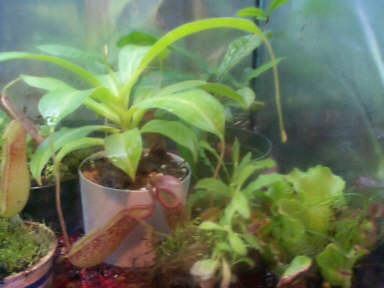
indoors in the terrariums. My Nepenthes madagascariensis
(which I believe that's what it is) seems fine at 80F! It used to be at 75,
but since I got new lights, I swear it is doing better. Maybe it's not
that one...Here is a picture of it:
Water & Humidity:
- Lowlands and Highlands both
like high humidity, and watering should be done when the soil starts to look
dry on the top.
Light:
- Full sun is recommended for
Nepenthes according to many text. For indoors, provide as much light as you would for Venus
Fly Traps (See VFT's
for my light-advice). There are a few species that may not like the
full light -- if leaves start to turn red and brown, try cutting down the
light a little. I know from experience that a few will grow better with
indirect light.
Asexual Reproduction:
- Stem Cuttings: When the
plant has a healthy stem, cut of a piece with 1-3 nodes. Be sure not to cut
back too much of the stem, or the entire plant will die. Cut about 1/2 of
the leaf, Dust the cuts with fungicide, and the stem cutting with rooting
hormone and fungicide (Rootone works well, it is both a rooting hormone and
fungicide). Place the cutting is moist media for now, and place in
high sunlight with average temperatures. I have put my cuttings of N.
gracilis in a cup of water, and waiting until roots and new leaves appear
before placing in media. I also put one cutting low light for 2 weeks to
encourage faster root growth. I have used Superthrive with 1/2 of my
cuttings, and I did see a difference-- those plants with Superthrive did
grow faster and put out more roots. Unfortunately, I did not have a working
camcorder, and hence, no pictures. Once the cuttings have well
rooted and start to put out new leaves, then transplant CAREFULLY into a
larger pot.
Sexual Reproduction:
- Nepenthes are dioecious
(male and female flowers exist on different plants). If you have several
plants, and a few are blooming, then you may be able to pollinate them. When
I make a section on pollination, I will go a little further there.
 Picture available at the CP
Database, do a search on Nepenthes & the species.
Picture available at the CP
Database, do a search on Nepenthes & the species.
- N. burbidgeae
- Another climbing Nepenthes with
leaves that can reach up to 15 inches, while traps can reach 6-8 inches
long!
-
- N. gymnamphora
- Good for Terrariums.
-
- N. hamata
- This is one expensive plant! I
never can find it under $100, but I really want this puppy. It is most
likely the most dangerous looking Nepenthes there is, even moreso than the
N. bicalcarata. One look from the CP database and you will see why.
Only a few growers have it, and it's never a good size plant. The peristome of the trap is
not smooth and graceful like other Nepenthes, but has teeth curved inwards,
and are supposedly sharp! I was told that it can grow into a 50
gallon terrarium up on it's side comfortably. Andrew Wistuba said
mature plants have leaves up to 4 inches and a slow grower.
- N. khasiana
Picture available at Dangerous
Plants!
- Thanks to tissue culture, this plant is
readily available from several growers. It grows unaffected when
temperatures dip to the thirties, and can actually grow back if hit by a
small freeze. Pitchers
can be up to eight inches long, with heavy red coloration at the top.
There is a bulge below the midpoint of the pitcher, moreso than other
plants. Hard to
propagate from cuttings, so you may have to rely on seeds or tissue culture.
I may get this one next year or so...
-
- N. madagascariensis
- I think I have two of these...
I learned the hard way that they can't take direct light. They like indirect or
soft light. I say I think I have two because I picked these up from
Home Depot last year. One I placed in my low-light terrarium, and seems to
be doing well, while the other I experimented with...it looks
horrible! I'm trying to verify if it truly is madagascariensis
before I tell you more about it.
-
- N. sanguinea
Picture available at Dangerous
Plants!
- Fast growing Nepenthes vine,
native to Malaysia. Pitchers can be up to 12 inches, looks great in
the Red Form. The upper pitchers are more funnel-shapped, and are
mainly green. Noted to be good for a terrarium, but I see you need a
large one! Have found it for sale at only a few places.
-
- N. tentaculata
- Good for Terrariums.
-
- N. veitchii
- Good for Terrariums.
-
- N. ventricosa (Not
a great picture...) Better picture at Dangerous
Plants!
- Good for Terrariums, and I've
found it for sale in several places on the internet. Native to the
Philippines. A low growing vine, with round pitchers with no wings.
Pitchers can be up to five inches, and have redish blotches. Upper pitchers
are smaller, and are yellowish. Can tolerate low temperatures
for brief periods of time.

Last Update April 13, 2000

Since 2/22/2000