
Aristolochia erecta or Aristolochia
longiflora
Aristolochiaceae Family
These pictures taken September 5th, 1997, the day before I got married.
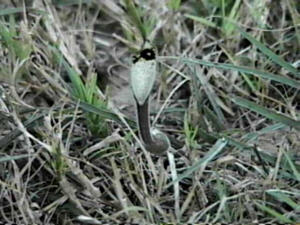
The flower
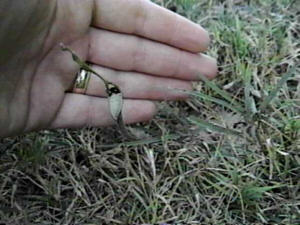
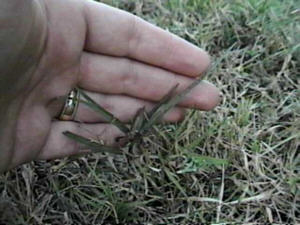
That's my hand proposing to the flower.
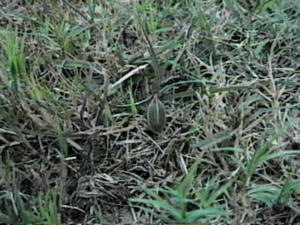
Thats the Seed pod in the middle
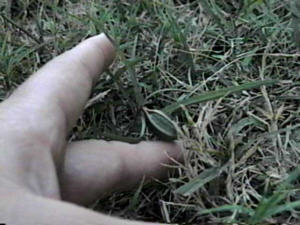
The seed pod pointed out.
The leaves blend in very well with any
Native grasses, making it difficult to find.
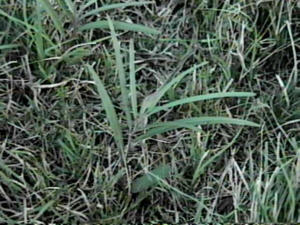
Two more plants.
I found this plant when I was around 13, thinking it was carnivorous. Years later, in 1995, I discovered the Carnivorous Plant Internet Discussion Group, and mentioned it. Jan informed me that it was not carnivorous, but related to the Dutchman's Pipe. The trap actually captures the insect not to digest it, but to ensure pollination! Insects are lured to this opening of the trap, then they go down into the tube. The plant senses the prey, closes the opening, and the insect is forced to spend it's remaining time inside. The insect ( bored to death ) will at least pollinate the flower before dying.
I found it grows underground stolons, and can spread rapidly this way. It is very VERY drought tolerant... I found small rhizomes underground that I believe belong to this plant, which accounts for its survival in Texas heat/drought. It's very endangered and I have VERY few. It was mentioned in Texas Highway Magazine years ago (Trying to dig up that article to find out more about it) and so far, I can't get it to bloom in cultivation, so no seeds are available
It dies back in the winter I noticed, but returns after a good rain in the spring. The soil there is very inorganic, semi-rocky, with some footc traffic. It doesn't get watered often, so the grass relies on rainfall. These blooms appeared September 1997 last, and the seed pods followed closely thereafter. We had a bad drought in 1998, I only saw it once blooming. In 1999, I can't find any plants in the area, but I do have some growing in pots around the house. No blooms there yet either.
December 3rd, 1999 I found the plant at a Texas A&M Website, http://csdl.tamu.edu/FLORA/NAV-OUTCROP/OUTCROP2B.HTML Through them and Monique Reed, The plant I have is not commonly known as the Texas Black Flower, but Pipevine or Swan Flower. They also state that this plant is the sole food of the larva of the gorgeous Pipevine Swallowtail butterfly. Also, they gave a good reason why I haven't found many lately. There is a black and red caterpillar that devours the entire plant, sometimes reducing them to leafless nubs.

Last update 04/13/00
Since 2/22/2000