American Pitcher
Plants

For many, this is the
easiest group to grow. They are herbaceous perennials with underground rhizomes, and can quickly spread if given a large growing
space. The interior walls of the pitchers are very waxy and slippery, so
insects will lose their foothold when crawling inside and fall into the trap to be intoxicated
further by the nectars, then ultimately dying and digested.
There are
nine species, but numerous hybrids. Beginners to this group shouldn't have
problems growing these plants indoors, and in many cases, outdoors. Be
sure to get a plant with a low mature height if you are growing them indoors (rubra,
purpurea, psittaciana).
Growing Media:
-
While outside, I
grow mine in either pure Sphagnum moss or a mixture of peat and perlite.
Temperatures:
-
Ideally, summer
should be around 70-95F, while winter months 35-50F. All these plants
can take a light frost, and S. purpurea ssp. purpurea
can go below freezing if for short periods of time. All pitcher plants
should go into dormancy for 3-5 months; I've noticed they stunt their growth
for about the same period of time if you try to grow them
year-round.
Water &
Humidity:
-
All of these
pitcher plants can grow in water logged soil, but will die if submerged in
water too long. High humidity is a must. Lower the water &
humidity for the winter dormancy. If grown indoors, they can grow in pots
sitting in water trays just as well.
Light:
-
Full sun is
required, or 12-16 hours of light inside. Pitchers will have better
coloration if given full or direct sunlight. When receiving inadequate
light, pitchers will be twisted and falling over.
Asexual
Reproduction:
- The simplest way is to
remove a leaf with a piece of
the rhizome on it. Place the tip in moss after dipping it in a
fungicide, and give it high humidity and
light. Keep around 70-85F, and give it a few months.
- Another method is to cut
the underground rhizomes into 1" pieces, keep what roots are there. Place
them inside some sphagnum moss; give plenty of light and humidity.
Give a few months.
The last method is only available for large plants; cut apart the crown into
several pieces, making sure each piece has a part of the rhizome and roots.
Repot each one after dusting the cuts with fungicide, and continue growing.
The individual plants will go through a short period of shock, but will
quickly continue growing.
Sexual
Reproduction:
-
Plants are rarely
self-pollinating, and when they are, very few seeds are produced. Cross-pollination provides the most seeds. when flowers open, pollen
is shed from the anthers. Transfer the pollen to the pistils, and the
ovary should swells in 3-5 months. This is very difficult to do when
grown in terrariums, because the flowers are heavily susceptible to fungus.
Pest & Disease Problems:
- The most recent
problem I am having are plants being gluttonous pigs. When the
pitchers are full of bugs (and I mean FULL) the decomposing insects
sometimes infects the pitchers, and they must be cut off from the base of
the plants. The other problem consist of bugs making a daring escape,
as seen below.

Grasshopper Houdini!
The Nine species
include ( I underlined those species I do currently grow) :
-
S.
alabamensis, alata, flava, leucophylla, minor,
orephila, psittaciana, purpurea, rubra.
- S. alabamensis :
- Erect leaves up to 20 inches.
Green pitchers with red/burgandy
veins. Not easy to find, it is considered endangered. Last place I saw it
for sale was www.cpjungle.com
 |
-
S. alata :
- Commonly call the Pale Trumpet
Plant. Distinct leaves are green to yellow, and can have red veining/
red coloration at the tops. Pitchers up to 30". Flowers have a
distinct pungent odor. Easily purchased from many sellers.
|

© Joe Harden |
-
S. flava :
- Known as the Yellow trumpet
plant. Pitchers grow up to 40", and are also green to yellow --
however, there are red blotches at the top of the leaves. The entire
pitcher can turn red in the summertime. Puts out yellow flowers. The
hood prevents rain from entering the pitcher, and allows flying insects to
land before falling into the funnel of death. "Typical Form"
is the name given to the natural S. flava, with green pitchers and
a red throat. "Veined Forms" have a much redder throat.
"Coppertop" have heavy red veins, and a copper color to the upper
pitcher. "All Green" lacks all red pigmentation. "Red
Tube" has a deep red tub, with green lip and throat. Found from
many sellers.
|
-
S. leucophylla :
- Leaves can get up to 40",
and is easily identified by the white coloration
at the top of the pitchers. Tops can also have red to green veins.
Considered the most beautiful of the pitcher plants, and insects think so
too. This plant is known to fill up faster than the rest. Unfortunately, they are widely used for cut floral arrangements. Easily
found.

© Joe Harden |
-
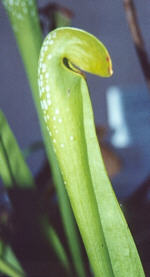
S. minor :
- 30" maximum height green
pitchers, with red and yellow coloration. The most obvious
characteristic is the hood curves over the opening. My personal pet peeve
about this is the inability to pull the hood aside to peek into the belly of
the plant. Once I get a large pitcher that I know is full, I'll cut it open
and get a picture here. Easily purchased from the
suppliers.
|
-
-
S. oreophila :
- Pitcher plant that can get up
to 30", and has green to yellow pitchers with red coloration, and a contracted
hood. Easily confused with S. flava & alata.
Difficult to find for sale anywhere, also endangered. The last place I
saw it for sale was www.cpjungle.com
|

© 1997 Mark Pogany. S. psittaciana 'Giant' at Lee's
Botanical Gardens; Labelle, Florida.

© Tobias Isenberg
|
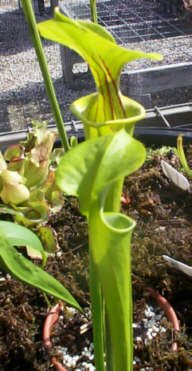
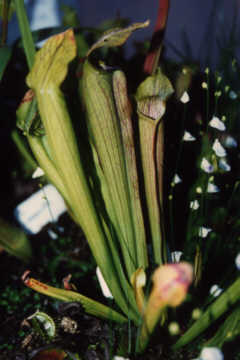
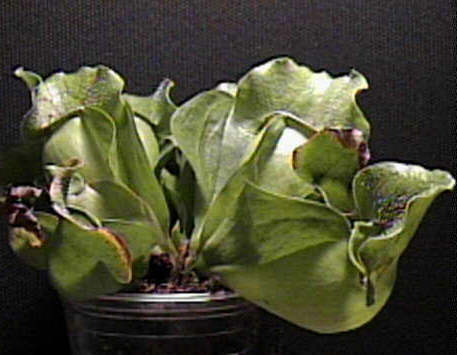
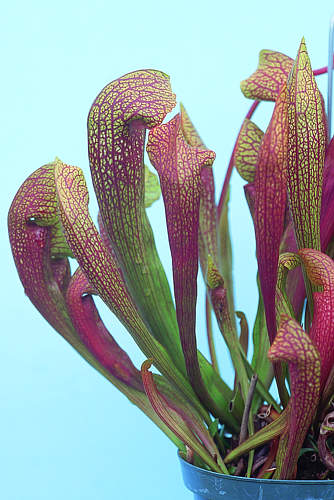
- S. psittaciana
:
- 12" tall/long
pitchers, and distinct traps' -- the hood is curved inward almost
like it is not fully opened somewhat like S. minor, but the top of
the trap is much bigger. Leaves are red to green with
purple coloration. Very distinct feature is that the leaves
are most procumbent of the American Pitcher plants, as seen in the
plants above. If grown in a terrarium, be sure to give
plenty of wide space for it. Not as easy to find from some
buyers.
|
-
|


Above Pictures © 6/97 Mark Pogany. Eagle Creek, Ohio.


Above pictures © Joe Harden
|
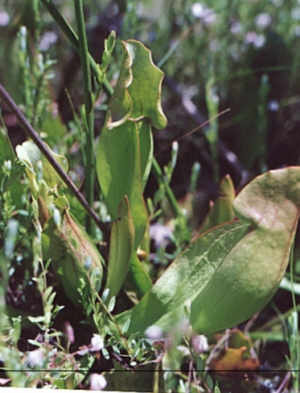
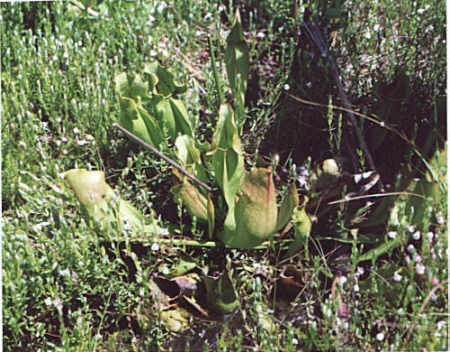
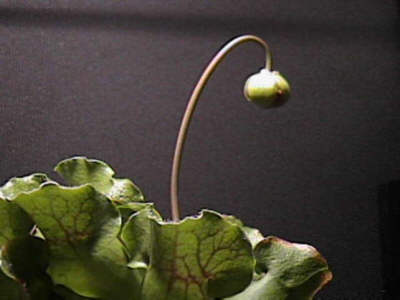
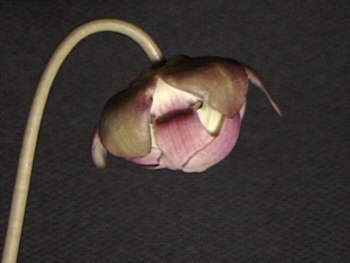
- S. purpurea :
- A Common pitcher plant,
reaching 18". Normal green pitchers with red markings, that
can turn completely red in the full sun. Pitchers are more
procumbent, instead of upright, and flowers have red to purple
petals. There is a variant that has completely green flowers
and leaves. A common plant to find in garden centers where
CP's are sold, and the first Pitcher Plant any collector should try
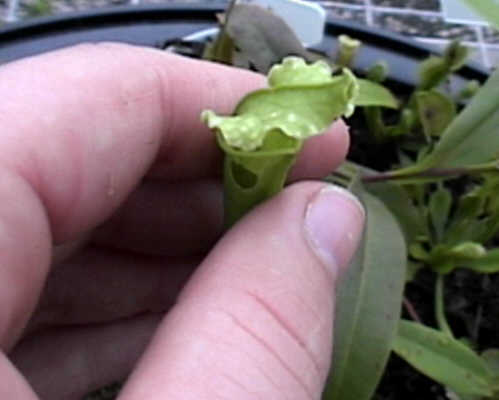
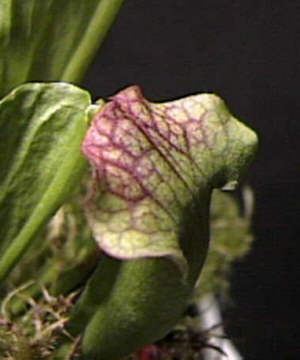
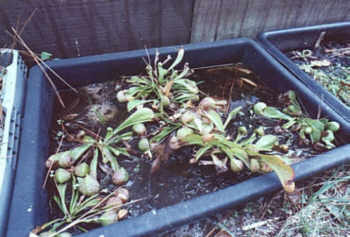
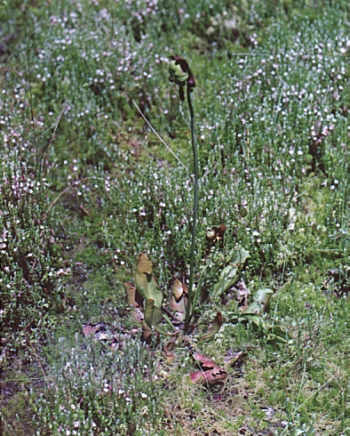
to grow. I have noticed if grown outside, the lids are curved inward
to the point as almost touching, as seen on the right.
If grown indoors, they only seem to wrap half-way around; my
pictures above are all indoor plants, while Mark's pictures are
those growing outdoors.
-
|

© Joe Harden |
- S. rubra :
- The Sweet pitcher plant. A
clump forming plant with erect pitchers reaching an average of 12", but
can reach 24". Dull green color with red to purple veining at the top. Smallest
of the pitcher plants. Flowers are small and bright red, very fragrant.
Insects are lured by the color and nectar in the mouth much moreso than the
rest of the Sarracenia. S. r. ssp. rubra is a popular species, reaching up
to 18", and highly fragrant. S. r. ssp. jonesii is
almost extinct, and pitchers can be 24" tall!. S.r. ssp gulfensis
has a weak scent. S.r. ssp alabamensis is also endangered,
with heights up to 20". S. rr. ssp. wherry has very
fragrant flowers also. Easy to find.
|

© 6/97 Mark Pogany.
|
There are MANY
hybrids and cultivars. The following are a few I plan on having available for
sale in 2000.
|
Sarracenia x
'Judith Hindle'
-
Gorgeous
hybrid created by Alan Hindle in 1985; named after his wife. Young
plants are nothing special -- green pitchers with yellow and white
hoods. As they mature, the pitchers turn burgundy with white and
yellow blotches.
|
Picture not available, but try www.californiacarnivores.com |
| Sarracenia
x 'Dixie Lace'
A great
hybrid that grows an average of 12 inches tall and 15 inches wide,
somewhat similar to S. psittacina's grow habit. Flowers in the
spring are maroon-red. A vigorous grower; seems to grow pitchers in
more abundance than other Sarracenia. (S. leucophylla x
wherryi) x (S. psittacina x purpurea)
|

©
Plants Delight
|
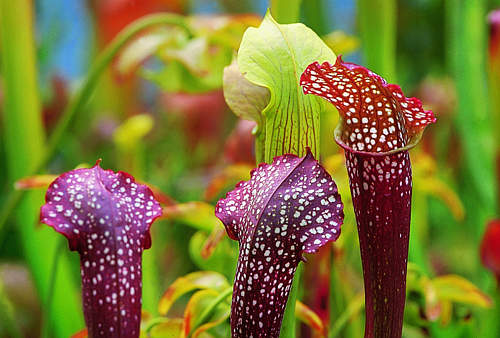
| Sarracenia x
'Ladies in Waiting'
Another great
variety that screams with beautiful color. Upright pitchers get up
to 24 inches tall. The mouths are bright red with white 'freckles''
near the hoods. Spring bloomer with maroon-red flowers. (S. leucophylla x
(S. rubra x S. psittacina) |

©
Plants Delight
|
Photo Contributors:
Tobias Isenberg : - Webpage
: Sarr. psittaciana
Plants Delight :
Sarr. x 'Ladies in Waiting', x 'Dixie Lace'
Last update 04/13/00

Since 2/22/2000