

If you wish to grow plants outside, there are few way of doing so : hanging baskets, small pots, or straight in the ground. The first two are no-brainers, just make sure the plants stay watered. But if you want to plant them in the ground, you may have to do some extra effort. The native soil may not be suitable, the water may have too many additives, and your environment may not be suitable to grow the plants. Here I explained a little of what I did in my back yard, and threw in some extra information. I hope it helps.
The critical points for outdoor growing include : growing medium, growing container, exposure, water source, and seasonal patterns. Each of these is as important as the next one -- think about it. If you have great water, sun exposure, planter boxes, a bad soil will still kill your plants. And if you have a tub full of Sphagnum moss and you're watering with tap water that contains minerals, your plants won't last too long. Make sure you have all these things in proper order before you jump into it, or you will be sorry.
Growing Medium:
First things first, you need to find the material you will grow your plants in. There is a lot of mixtures you can use. I use a mixture of 75% Sphagnum, and the rest a mixture of shredded peat moss and orchid bark, and sand. I've read where some people use sand and peat moss mixtures, that works too. You can also use perlite and vermiculite instead of orchid bark, I just wanted something more organic. Finding a good source of Sphagnum Moss, Peat, Perlite, Orchid bark, & Vermiculite will save you a great deal of money. Look in the Yellow pages under Garden Centers, and start calling Suppliers to see if 1.) Do they sell to the public and 2.) Do they get bales (That's a unit of measurement, usually 3.5 cubic feet to 6 cubic feet) of Sphagnum Moss, Peat Moss, etc. If you find a winner, then you just saved some money. Otherwise, I'm sorry, and hope you have deep pockets buying large quantities of small bags. For me, Central Garden Pet Supply in Texas worked perfect. Keep the number of your soil supplier; -- before you buy the soil, you now need to pick a growing container.
Growing Container
You can be very cheap and use a kiddy pool, but it looks tacky. Or you can go to the large home improvement warehouse in your city (or other garden centers) and look at the water garden department. These pre-formed sturdy tubs are great. If you can't dig a hole to accommodate it, then build a small deck around it. Or just pile up some rocks for a more natural look. For me, I bought a whisky barrel (that still smells of whisky) and a barrel liner with a spout on the end (To release the water when it gets to high). One tip is to drill small holes for drainage one inch below the top. The plants will not be always sitting in standing water, and will appreciate that. If you plan on growing some plants that like being in standing water, I suggest you place the container on a slant, to allow water to run off the edge on a side. I do NOT recommend the half-liner in a whisky barrel to be placed in a whiskey barrel -- heat can build up in that gap, heating up the water more than desired. For small jobs, pots and planters can be found here. Below is a small mini-bog I have in one of our nursery greenhouses. It may be a half liner, but its under shade cloth and the plants aren't complaining yet.
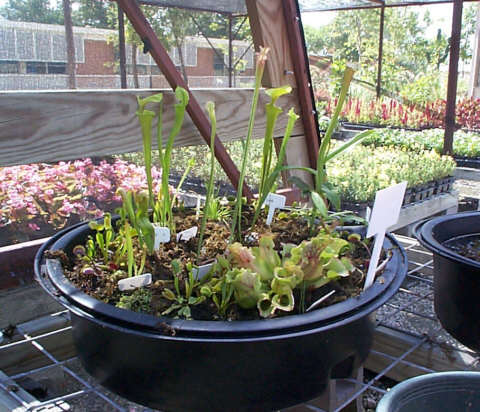
No matter what container you use, keep in mind kids and dogs will go exploring here, so you may need some type of barrier ( I need one from my dog...) Also, stay away from material that can heat up quickly and get cold too easily, like metal & aluminum. I saw a picture of someone using an antique bathtub, and it looked great. Once you pick out the container, buy your soil, and look for a place to grow your plants.
Exposure
For me, the Texas sun is pretty mean -- sure the plants can tolerate 100F, but they would do better at 90-95F. And the sun is blaring down pretty hard, some plants will even wilt after several hours of the direct heat. You can place the plants under trees that give some filtered shade, or create some artifical shade. I prefer to use shade cloth; I can remove it in the spring and fall when we no longer get up to 95F, whereas your stuck with what the tree gives you. A shade cloth is what is on the greenhouse above, you can hardly see it in the left & right side, but you do see a corner of another shadecloth at the top corner. When choosing an area, keep in mind your plants requirements. Most CP will enjoy the filtered shade, while some only tolerate full shade. If you live somewhere that doesn't get too hot, then you may not need the shade at all.
Water
Now the most important issue -- water. Indeed, I said all these criteria are important. But you only have to pick the soil once, the container once, the area maybe twice if you put it in a bad spot...but you will have to water your plants indefinitely. I do not have access to favorable water out of the tap -- most people don't. Buying bottled water can get quickly expensive. Your can buy a reverse osmosis unit, but it is pricey. However, an air conditioner that cools your house is the ideal solution -- assuming your have one. The AC sucks air into the unit, condensation occurs, and water accumulates on the cooling pads. After awhile, the water runs down into a pan, and out of the unit through a pipe, to drip to the ground somewhere outside the house. That water is as pure as you want it. On a hot summer day, I can collect 5-6 gallons of water easy. On a spring day, 1 gallon a day is average. If you are lucky, you can run a pipe/hose from that outlet over to the carnivorous plant bog. This water comes out cool, so maybe, just maybe, I can grow my cobra lilies right where the water comes in. I'll know by the end of July. (Update! It's September, and they haven't died, but they haven't prospered either...)If so, I know several people that kill their cobra lilies will have another shot at keeping them. Either way, make sure you have access to water for a long time.
Seasonal Patterns
Hopefully, you are putting in plants that can tolerate the seasons you expect to encounter. If you expect chilly or freezing winters, by all means grow Nepenthes in the spring and summer, but you better relocate them in the fall! This goes for some other carnivorous plants as well, so read up on "Growing CP's" to see what your plants' winter requirements are. If your plants do tolerate low temperatures, and you don't want to bring them in, they you need to protect them from lower than tolerated temperatures. Let the water dry up halfway in your container, then cut off the water supply. Mulch the garden with about 6-10 inches of natural mulch (shredded bark works well, or even grass clippings). The mulch will keep the plants warm when cold, and insulate the soil from losing more water. On top of that, what little decomposition takes place, will benefit the plants underneath. If a hard freeze is expected, then cover the mulch with thick burlap or plastic. Once winter is over, remove the mulch, and begin the water supply again. If your plants are in small containers, you can always bring them into the garage when a hard cold freeze is expected....
To sum it up, you need to make sure you have good soil mixtures, containers, proper placement in your yard, and a constant supply of pure water if you want your plants outside. This information is what I gathered over experience -- this has worked for me. If you have other helpful tips, please tell me about them.
Good luck!!

Last update 05/01/02
Since 2/22/2000