My Greenhouse
This has been one big learning experience, and
I decided to put what I thought was relevant here.
I live in San Antonio, Texas. It
gets blazingly hot down here, even reaching in the 80'sF during January. This is
great for some plants, but its horrible when we go from freezing weather to hot
weather in a few days. My plants really don't know if they should be
dormant or not. Worse yet, I put plastic over my greenhouse in the
winter to keep it warmer on the inside with natural heat from the sun. Well, in
February it got up to 85F outside, 100F inside! My single fan almost isn't
enough.

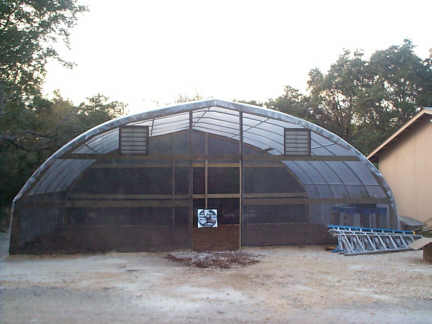
Above is a picture of it finished in November 1999. I have two vents in the front, and the open when the fan (not installed
yet)
kicks on. There is full sun on the right side, and Oak trees shade the
left side for the afternoon. I am forced by some higher powers to share
this with my brother. That's fine...I got the right side, he got the
left.

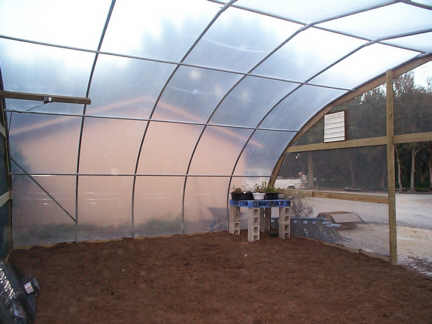
My entire collection as of November 1999. Pretty pathetic.
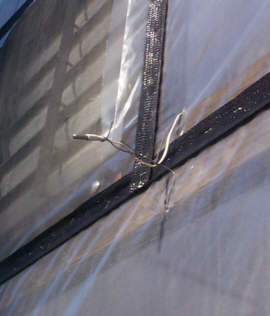
The plastic is double poly, and is inflated by the small fan in the middle left
of the picture. Make sure if you do this you cut a small hole on the
opposite side, so you won't blow up the plastic. My tables are as cheap as
you can get -- cinderblocks and a plastic pallet. I built some wooden
tables a week after this picture was made, seen below. If you see it, I did get shade-cloth on the sides, but
didn't have enough for the top, it's been ordered.

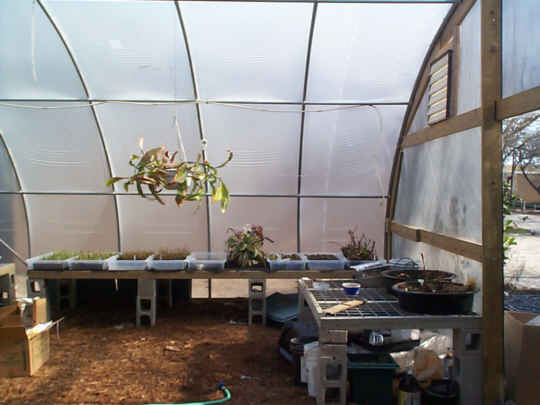
The collection as of January 17th 2000! This is after I
had a serious heater malfunction, which cooked my plants. My wonderful
Nepenthes x coccinea looks very pathetic. At this time, I thought I would be
throwing away most of my collection.
My stock almost ready for sale was pretty much everything in the large plastic
tubs. Notice I have a thick layer of Mulch on the ground. If you water the
mulch thoroughly whenever the heater is on, the greenhouse will maintain a good level of
humidity. I built some new tables as you can see, from wolmanized lumber
and wire. I really need to clean up
that mess under the right table...

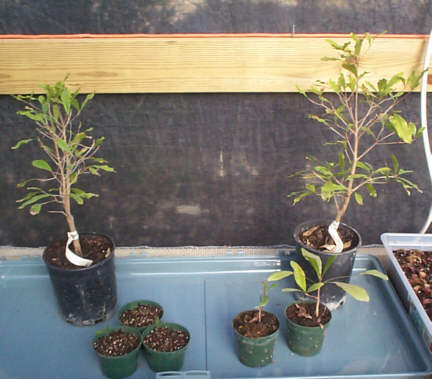
I used to keep all my plants in individual water
trays. After dividing and replanting, I found out
I would need over 100 little trays, which wouldn't be very efficient for the
summer. I went to Target and found these large 'underbed' plastic boxes on
clearance in January. You can pop the lids off and have the perfect water tray
for many plants. The containers themselves are 3 inches deep (left), while the
lids are 1 inch deep (right). The plants on the right are Miracle
Fruit, another odd plant I grow.

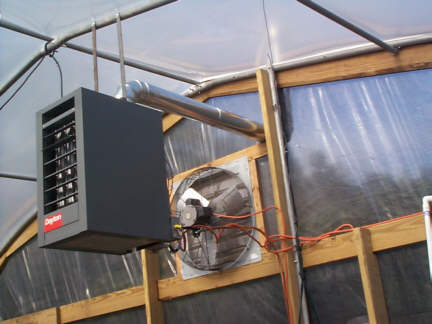
Talking about heaters, here is mine. One big mama-jama
--
It's a propane heater from Grainger. Make sure with any
gas heater you use that you have the exhaust leaving the greenhouse.
The heater turns
on at 50F- it has a separate thermometer.
I
didn't plan on having the fan right behind it, and it will be moved to the side
in a month or so.


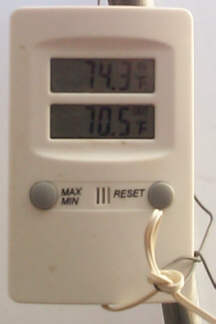
\There are many types of thermometers out there. I suggest
you
get on that has a Minimum & Maximum reading, with outside &
inside
measuring points. The unit goes inside the greenhouse, while the wire
trails to the outside.
This lets you know just how hot and cold it's getting. More expensive models
(which I have on order)
can actually tell you the times of the day it was the hottest/coldest. If anyone
is looking for one, email me.


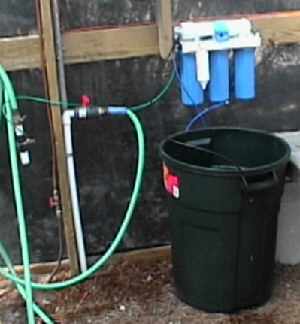
I purchased a Reverse Osmosis
Unit February 2000 from Sam's Club. It's manufactured by Premier Manufactured
Systems Inc. They can be found on the web at http://www.premierh2o.com/
. I didn't plan on getting one so soon, but the greenhouse was reaching
over 95F due to a light winter, and my air conditioner wasn't putting out enough
water to keep up. The picture on the left is the unit by itself, while the
picture on the right is my entire setup. Below is an explanation of how
the RO unit works.
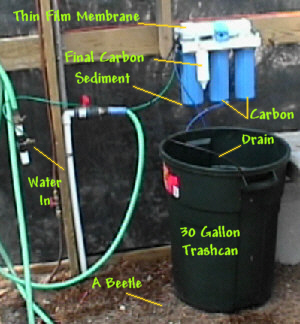
The water comes in from any garden house. The brand I purchased was initially
designed to hook into a kitchen sink, so i just used a closed PVC pipe end that
screws onto a garden hose. The water pressure is high enough that no
electricity is required, and there is a pressure valve installed in case the
pressure gets too high. Water first enters the Sediment Filter, then goes
through two Carbon Filters. Afterwards, it will go through a Thin Film
Membrane Filter, and 9/10 of the water will be released through a Drain hose
that I just allow to drip on the Greenhouse floor. The remainder of that
water goes through the Final Carbon Filter, then drips into my Plastic Trashcan.
The unit supposedly releases 5 gallons per day, which will be enough for me if
left on continuously.

Last update 05/01/02

Since 2/22/2000