
The Venus Flytrap

Easiest CP to find. Relatively cheap
Perfect for the beginner
Grows great in terrariums, until it blooms.
Dormancy required


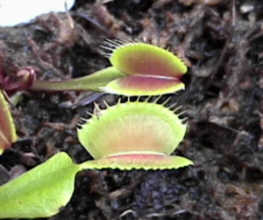
The Venus Fly Trap is probably the most common of the carnivorous plants, and usually the first plant CP collectors get their hands on (it was mine). There are a several types available: Giant, regular, Green Dragon, Red leaf, Akuyi-Red, Shark's Tooth, and Cupped. There has been a new introduction in Fall 1999, the 'Red Piranha'. So far, I have the regular, Akuyi-Red, and Shark's Tooth (pictured above). I plan on selling some Green Dragon next year.
The
top one is a young Akuyi-Red, bottom is Regular.
The VFT is a un-branched clumping plant formed from a rhizome. The leaves form a rosette with trap at the end of the leaf. There are teeth along the edges of the leaf, which give it the exotic and common appearance we all recognize. There are small 'hairs' sticking out inside the traps. When these hairs are moved, the trap will quickly close shut, and hopefully catch its prey. The VFT then crushes its prey, and absorbs the wholesome bug juice-ness. A few days later, the trap will reopen leaving only an empty exoskeleton. Very rare, but sometimes the VFT makes a 'double-trap' like the one below.

Early in the spring, a flower bud will form in the middle of the rosette, and leaf growth will halt. If you want you flytrap to continue growing, cut off the flower stalk. If you want to see a bloom and hopefully collect seeds, then by all means let it continue growing. A long stalk will form, then 1-12 flowers will appear in a cluster on the end. Brushing the flowers with a Q-tip can pollinate the flowers.


© Joe
Harden
Growing Media:
I have grown VFT's indoors in a mixture of 1 part peat moss, perlite, and vermiculite. I topdressed the pots with some sphagnum to hide the perlite & give a more pleasant appearance. The only problem with Live sphagnum is that it will need to be trimmed back often. For my outdoor mini-bog, I grow them in pure Sphagnum moss. For pots outdoors, I've stuck with the indoor mix as listed above.
Temperatures:
Ideal temperatures are 70-95 F in the summer, and 35-50 in the winter. If the summer gets hotter, then you might want to provide some filtered shade or the plants will wilt slightly. As for the winter, I can't stress enough the fact you need to give them lower temperatures, whether or not your winters are that cold. Allow the soil to dry out 75% or so (not completely), and place in the back of your fridge. Every now and then, check to make sure the soil isn't completely dry. Keep it there for about 4-5 months. When you bring them out, they may put out a few leaves then bloom right away.
Water & Humidity:
VFT's can grow in water logged soil, but will die if submerged in water too long. High humidity is a must. Lower the water & humidity for the winter dormancy.
Light:
Full sun is required, or 12-16 hours of light inside. With the proper amount of light, traps will turn red, and the leaves will be long and narrow. If your leaves are short with wide 'wings', they need more light.
Asexual Reproduction:
Dig up the bulb, and you will notice each leaf connects to a bulb. Carefully peal off each leaf, keeping the white part intact. Place the leaves in damp soil, provide humidity and light, and small leaves should start to come out in a few months.
Sexual Reproduction:
When you have a bloom, try pollinating it with a Q-tip. After the petals drop, small seeds will form in the clusters. Collect and sow -- they should sprout in a few months.
Pest & Disease Problems:

:Last update 07/30/01
Since
2/22/2000